

About this position
Congressional District 1 (“CD1”) is one of Utah’s four seats in the U.S. House of Representatives. Utah has four House representatives who work full-time in Washington, D.C.
House members vote on issues like healthcare, taxes, public lands, infrastructure, immigration, and education. Because of this, these federal races can have a significant impact on both Utah and national policy. Federal congressional members also provide a myriad of services for their constituents.
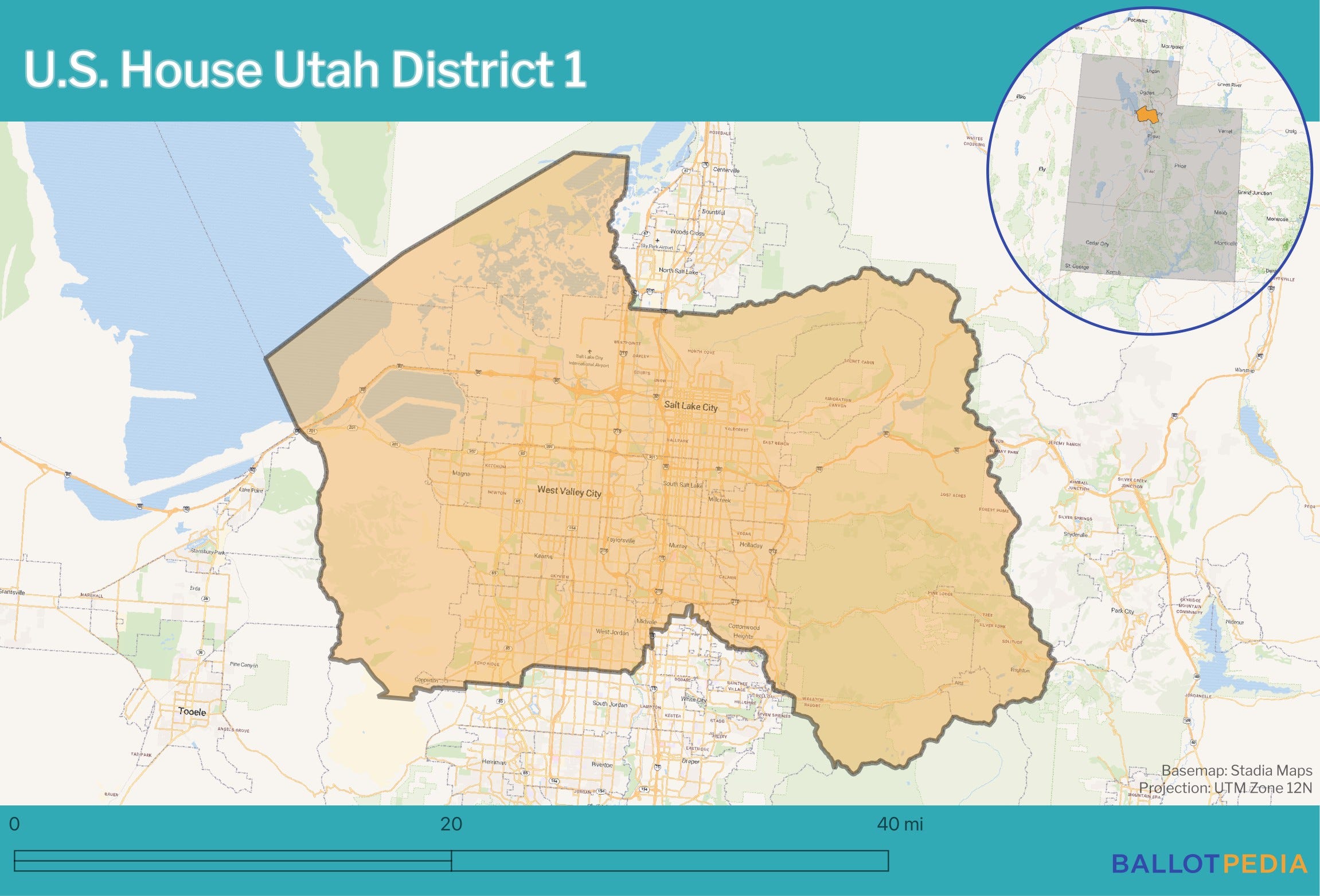
With the recent redistricting of federal house districts to match the terms in Utah’s Proposition 4, Congressional District 1 now covers much of Salt Lake City, down to mid-Salt Lake and Summit Counties

Candidates
Find what qualities the Network of Utah Moderates is looking for in candidates.
Use these guides as a starting point to do additional research. We recommend you reach out to candidates via phone, email, or meet them in person when possible to learn more about their issues and experience. Top priorities come from candidates’ official websites.
Ben McAdams
About: Originally from Bountiful, Utah. Mr. McAdams formerly served in the Salt Lake County mayor’s office as well as in Utah State Senate, as the mayor of South Salt Lake, and one term in the U.S. House from 2018–2020.
Top priorities: Lowering housing costs and building economic security for working families; defending democracy and the rule of law; protecting the environment; and defending human rights.
Our take: We’ve heard mixed reviews around Mr. McAdams. Some of our friends have had great working relationships with him, while others have shared negative experiences with Mr. McAdams. From the public record, we note that Mr. McAdams’ homeless proposals while Salt Lake County Mayor reduced the number of homeless shelter beds, along with endorsements he allegedly published without permission.
Most voters will recognize that, as the Democratic nominee for CD1, Mr. McAdams may be best positioned to stand up to the excesses of the current administration. If you’re on the fence, we recommend doing a deeper dive: see his voting record and social media.
Riley Owen, Republican nominee for CD1.
About: Mr. Owen, 27, started his career at the White House, focused on manufacturing and trade policy—and involved in federal response efforts for the COVID-19 pandemic. Later earned a Master of Public Policy at Oxford and was commissioned as an Intelligence Officer in the Navy Reserve. Started a wildlife conservative foundation using drone technology. Now at a defense technology startup helping Ukraine.
Top priorities from official website:
Strengthening Utah Community: expanded tax credits, 6 weeks paid material leave, zoning reform, social media age verification
Common Sense Solutions: banning stock trading, term and age limits, overturning Citizens United, fixing immigration
Economic Security Social: modernizing the military and technology, apprenticeships with manufacturers; helping the Great Salt Lake
Insights: We’ve had positive experiences, including a direct chat with Mr. Owen, who is running in a newly-created Democratic-leaning district. In particular, we were impressed by his experience, especially for such a young person—one of the first Gen Z Republican candidates for Congress. Mr. Owen seems truly committed to his principles and is campaigning on more classical conservation and bipartisan issues rather than culture war issues, which we appreciate.
Jesse West, Libertarian nominee for CD1.
About: 30 years old, attorney by trade and avid skier. Came to Utah to ski around 2018 and settled here.
Top priorities from official website:
Peace—no more forever wars, take care of veterans
Truth—no more wrongful convictions or death penalty
Freedom—Clear, accessible legal pathways to citizenship; free movement, legalize cannabis
Also working to protect the Great Salt Lake.
Insights: We find Mr. West’s tagline—”a vote for me is a vote to Ski not War”—a bit fun but perhaps not the seriousness we’re hoping for in a candidate. Candidly: we believe CD1, Utah’s only Democratic-leaning congressional district, will come down between the two major parties. That said, if you prefer non-traditional candidates and Mr. West’s policies intrigue you, reach out to him directly at libertywhale@pm.me.
Elias Henry Montgomery, Unaffiliated candidate for CD1.
About: Independent candidate offering a choice outside the traditional party system. Specifically says he is not a moderate or centrist; uses a “compass” filter to look at policies, trying to be consistent, objective, and principled. (Note: Could not find biographical information on his website)
Top priorities from official website:
Lower everyday costs. Promote owner-occupancy in housing; prioritize the “missing middle” housing; prioritize infrastructure like energy efficiency, water security, and transit.
Real systemic accountability. Break single-party monopolies and partisan gridlock.
A Government that Serves the People. Move decisions closer to local communities.
Insights: We appreciate Mr. Montgomery’s desire to be principled and consistent in policymaking, and some of us agree with many of his priorities and goal of balanced government. If you prefer non-traditional candidates, he may be your person.
Again, we believe that CD1, Utah’s only Democratic-leaning congressional district, will come down between the two major parties. If you prefer non-traditional candidates
Our Recommendation:
Rather than making an outright recommendation, we leave this race to the voters in CD1. Many voters have policy preferences that align them with one candidate in this race. For voters whose biggest hope is to see executive power checked, Mr. McAdams—as the Democratic nominee—is likely best positioned to do that.
At the same time, we recognize that Mr. Owen is one of the current Republicans most aligned with our values. He brings strong character and policy experience to the role; we anticipate that Mr. Owen would stand against executive overreach within his own party.
Frankly, both Mr. West (Libertarian) and Mr. Montgomery (unaffiliated) have interesting policy perspectives, should you prefer an option outside the two-party system. Strategically, we’ll note that a four-way race is especially hard for third-party and no-party candidates.